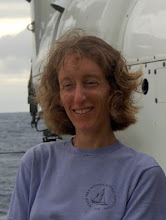
In September I attended NOAA's Science and Exploration Workshop for the Marianas Trench Marine National Monument. The workshop was held in association with the Oceans'11 IEEE/MTS conference at which I presented our work from last year's YK10-11 cruise: "International study of larval dispersal and population connectivity at hydrothermal vents in the U.S. Marianas Trench Marine National Monument," by Stace E. Beaulieu, Susan Mills, Lauren Mullineaux, Hiromi Watanabe, Florence Pradillon, and Shigeaki Kojima, abstract no. 110422-040.
Sunday, October 30, 2011


Sunday, June 26, 2011
Welcome to our 2011 Summer Student Fellow
This summer, we welcome Thomas Sayre-McCord as a Summer Student Fellow in our lab. Thomas is a physics major at the University of North Carolina. He is applying his interests in biophysics to the analyses of larval swimming velocities. Here, Thomas has one computer running Matlab routines and a second computer displaying a video frame grab from experiments on last year's Mariana cruise.


Thursday, December 30, 2010
Presentation at AGU Fall Meeting
Earlier this month, I attended the AGU Fall Meeting and presented the first results of our Mariana vent larval study. Click HERE for our abstract #OS13G-07, "Larval abundance and dispersal at deep-sea hydrothermal vents in the southern Mariana Trough." At the end of the talk, I showed a short video clip of live larvae, which you can view HERE (wmv file, ~4MB). Happy new year!
Friday, September 17, 2010
Jaa, mata (see you again)

The photo at left shows Guam on the starboard horizon, as we were returning to land on Sept. 15th. After our gear was safely unloaded onto a flat-bed truck, Susan and I caught a bus with our colleagues to the Guam Hilton. We had the good fortune to relax for a day, including snorkeling in the warm clear waters, and then we had to say goodbye. In Japanese there are so many different ways to say goodbye, but I am hoping that we can say "Jaa, mata" (jahh-mah-tah), which is an informal way of saying "see you again." This cruise was an incredibly enriching experience - both scientifically and culturally. Susan and I look forward to working on our samples and data back at home in Woods Hole.

 |
| Tomomi Ogura |
Wednesday, September 15, 2010
Last Shinkai Dive of the cruise

14-Sep-2010. Today our Chief Scientist Kojima-san returned to Snail site to recover our JAMSTEC collaborators’ demersal plankton pump on Dive 1228. Accompanying Kojima-san on the dive was our cruise mascot, “Gori-san” (shown in photo). We are hoping that Gori-san brought us good luck and that we will have a lot of biology work to do this evening, the last night at sea. I would like to again thank the Captain and everyone on board R/V Yokosuka who helped make this cruise such a great success. Arigatou gozaimasu (ah-ree-gah-tohh goh-zah-ee-mah-soo).
 |
| Sunset rays above Philippine Sea |
Tuesday, September 14, 2010
Like a kid in a candy store
13-Sep-2010

 As you can see, geophysicist Nobu Mochizuki was smiling and happy “like a kid in a candy store” this morning before his first dive ever in Shinkai. You can see the diversity of rock types collected on the cruise in the photo below (sulfides on left and basalts on right). Today I want to highlight something interesting that I learned during this cruise about how I use the English language. I learned that I often use expressions and idioms that are exclusive to native American English speakers. I learned over the past two weeks to use words with more of the correct meaning in a dictionary (or, in Japanese, “jisho,” pronounced gee-sho). I had planned on titling today’s blog “Icing on the cake” because we recovered the current meter mooring, and we now have data for the near-bottom flow during our larval collections. I talked with a couple of the scientists in the computer room, and we could not come up with a Japanese expression for “icing on the cake.” However, we did come up with an expression for Nobu being “tickled pink” – “hashagu” (ha-sha-goo) in Japanese.


Monday, September 13, 2010
Women working at sea
12-Sep-2010


 There are more women on board Cruise YK10-11 than have ever sailed before at one time on R/V Yokosuka. The science party has nine women, including our collaborator Florence Pradillon from JAMSTEC (see photo inside Shinkai before Dive 1226). While Florence was down on the seafloor, Susan and I worked on deck to clean our mooring gear for the shipment home. We were kneeling a lot, as you can see in the photo below. In the lowermost photo during the Shinkai recovery, you can see Hitomi Ikeda, the first female Shinkai mechanic. Also on board is Minamoto Mai, working on the ship’s crew as third electronics officer.


Subscribe to:
Posts (Atom)